


The Best Tiny Theologians Resources for Homeschool Families
One of the gifts of homeschooling is getting to think intentionally about what we want to fill our children’s days with. We choose the books they read, the history they study, the ideas they encounter, and the rhythms that shape their education. And for many Christian homeschool families, that means we also want the Bible and theology to be woven naturally into the school day.
But that can create its own kind of pressure. If you already have math, language arts, history, science, handwriting, read-alouds, and everything else spread across the kitchen table, adding an entire Bible curriculum can feel like one subject too many. You want your children to grow in biblical literacy. You want them to know what Christians believe and why we believe it. You want them to know something about church history, apologetics, missions, and even the languages the Bible was originally written in. But you may not want another workbook that requires thirty minutes of instruction every day.
That is actually one of the reasons so many Tiny Theologians resources work particularly well for homeschool families. They allow you to bring rich theological ideas into the school day in small, manageable pieces. You can add them to morning time, use them for memory work, study one card a week, or simply pull one out whenever you have ten extra minutes. You do not need to turn theology into another heavy academic subject in order to take it seriously.
If you’re looking for ways to incorporate more Bible, theology, and Christian history into your homeschool, here are some of our favorite places to start.
Tiny Bible Survey: Build the Big Picture
One of the most important things we can give our children is a framework for understanding the Bible as one unified story. Children often know individual Bible stories long before they understand how those stories fit together. They know Noah and the ark, David and Goliath, Daniel and the lions’ den, and Jesus feeding the five thousand—but they may not know where those stories belong in the Bible or how they contribute to the unfolding story of redemption.
Tiny Bible Survey helps children develop that bigger framework. It introduces them to the books of the Bible, helping them understand what each book is about and where it fits in the biblical story. For homeschool families, this works beautifully as part of morning time or alongside your regular Bible reading. You might study one book at a time, locate it in your Bible, talk about its main themes, and gradually help your children build a mental map of Scripture.
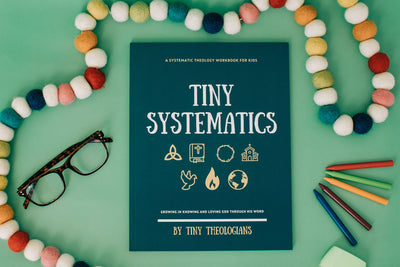
Tiny Systematics: Teach Them What Christians Believe
Children are already theologians because they are already forming ideas about God. The question is whether those ideas are being shaped by Scripture. Tiny Systematics introduces children to the major doctrines of the Christian faith and gives them vocabulary for understanding truths about God, humanity, sin, salvation, the church, and more.
This is an easy resource to work into a homeschool morning basket. Choose one theological term each week, read the definition together, look up the accompanying Scripture, and revisit it throughout the week. Over time, children begin building a theological vocabulary that gives them categories for understanding what they encounter in Scripture.
Tiny Apologetics: Help Them Understand Why We Believe
As children grow, they begin asking bigger questions. How do we know God exists? Can we trust the Bible? Did Jesus really rise from the dead? How is Christianity different from other religions? Those questions are not interruptions to discipleship; they are opportunities for it.
Tiny Apologetics gives children an age-appropriate introduction to reasons for the Christian faith. In a homeschool setting, these cards can become wonderful conversation starters. Rather than trying to complete an entire apologetics course, choose one question and spend time talking about it together. Older elementary children can look up additional Scripture passages or explain the answer back to you in their own words.
Tiny Church History: Introduce Them to the Christians Who Came Before Us
Church history reminds our children that Christianity did not begin with our family, our church, or even our denomination. For two thousand years, Christians around the world have followed Jesus, defended the faith, translated Scripture, served their neighbors, endured persecution, and carried the gospel to new places.
Tiny Church History introduces children to important people and moments from the history of the church. These cards pair especially well with a history curriculum. Keep them nearby and pull out the relevant people as you move through different eras, or choose one figure each week to learn about during morning time. They can help children begin connecting the history of the world with the history of Christ’s church.
Tiny Biblical Languages: Give Them a Peek Behind Their English Bible
You certainly do not need to teach your elementary student Greek or Hebrew in order to give them a strong Christian education. But introducing children to the biblical languages can help them understand something important: the Bible has a real history. The words they read in English have been carefully translated from texts originally written in Hebrew, Aramaic, and Greek.
Tiny Biblical Languages gives children a fun introduction to that world. It can be a particularly good fit for language-loving kids or families studying the ancient world. Instead of treating Greek and Hebrew as something reserved for pastors and scholars, children get an early glimpse at the languages God used to give us His Word.
ABC Scripture Memory: Make God’s Word Part of Memory Work
Homeschool families already understand the value of memory work. We memorize math facts, poems, historical dates, grammar rules, and vocabulary. Why not intentionally include Scripture?
Our ABC Scripture Memory resource gives families a simple framework for hiding God’s Word in their hearts. You can introduce one verse at a time and recite it together at the beginning of your school day. Younger children may work on one phrase at a time, while older children can memorize the entire passage. The beauty of Scripture memory is that it requires very little preparation while giving your children words of truth they can carry for years.
Mission Curriculum: Help Them See God’s Work Around the World
We also want our children to understand that the story of the gospel is bigger than their own family and local church. God is gathering a people for Himself from every tribe, tongue, people, and nation, and learning about missions can help children develop a bigger picture of His work in the world.
Our Mission Curriculum gives families a more structured way to explore missions together. This is a wonderful option if you want to dedicate a season of your homeschool year to learning about the Great Commission, missionaries, and the global church. It can also pair naturally with geography as children learn about different places and the people who live there.
The good news is that you do not need to use all of these resources at once. In fact, I wouldn’t recommend it. Think about what would serve your family in the season you are in right now. Maybe this semester you work through Tiny Bible Survey and memorize Scripture. Next semester, you add Tiny Church History alongside your history curriculum. Perhaps Tiny Apologetics stays in your morning basket and comes out once a week for a Friday discussion.
A simple rhythm might be five minutes at the beginning of your school day: recite your current Scripture memory verse, review one theology or Bible card, and pray together. That’s it. Those few minutes, repeated over the course of an entire school year, add up to a remarkable amount of biblical and theological learning.
Christian education does not require us to recreate seminary around the kitchen table. Our goal is not to see how many theological terms our eight-year-old can define. We are giving our children categories that will help them know God, understand His Word, recognize truth, and see themselves as part of the long story of Christ’s church.
So start small. Choose the area where you most want your family to grow, find a Tiny Theologians resource that supports it, and tuck it into a rhythm you already have.
You might be surprised how much theology can fit into ten minutes before math.