


What Age Should I Start Teaching Theology?
One of the questions I hear from parents most often is, "When should I start teaching my child theology?"
Usually what they're really asking is whether their child is old enough to understand it. We tend to think of theology as something reserved for adults, or perhaps for students sitting in seminary classrooms with stacks of commentaries spread across a desk. The word itself can feel intimidating. If theology is the study of God, surely there must come a point when our children are mature enough to begin learning it.
The surprising answer is that they already have.
Every child is a theologian. Every child is forming ideas about who God is, what He is like, and how He relates to the world. Long before children can explain the doctrine of the Trinity or articulate the gospel, they are making conclusions about God from what they see, hear, and experience. They notice whether prayer is something their parents actually believe matters. They hear the songs we sing in church. They ask why Grandma died or why the stars shine or why Jesus had to go to the cross. These aren't interruptions to childhood. They are the beginning of theology.
The question, then, is not whether our children will become theologians. They will. The question is who will shape their theology.
Every Child Is Already Learning About God
This is why the Bible never presents the knowledge of God as something we postpone until children reach a certain age. When Moses instructed Israel in Deuteronomy 6, he did not tell parents to wait until their children could reason like adults. Instead, he called them to speak of God's commands throughout the ordinary moments of family life: when sitting in the house, walking along the road, lying down at night, and getting up in the morning. The assumption is that children grow in their knowledge of God gradually, through thousands of ordinary conversations that together form a lifetime of discipleship.
That should be deeply encouraging to parents.
Teaching theology is not primarily about setting aside an hour each day for a formal lesson. Certainly there is value in intentional Bible study, but most of our children's understanding of God will be shaped in the ordinary rhythms of life. They learn that God is Creator while watching a butterfly land on a flower. They learn that He is faithful when we remind them that His promises never fail. They learn that He is holy when we talk honestly about our own sin and our need for Christ's forgiveness. Theology is woven into everyday life because God Himself is present in every part of it.
Young Children Can Understand Big Truths
Of course, the way we teach a two-year-old will look different from the way we teach a ten-year-old. We should never expect children to grasp truths that belong to years of maturity and study. At the same time, we should be careful not to underestimate what young children are capable of learning. Children often understand more than we realize, particularly when profound truths are explained with simple language and faithful illustrations. A toddler may not define God's omnipresence, but she can begin to understand that God is always with His people. A preschooler may not explain justification, but he can rejoice that Jesus forgives sinners. The goal is never to simplify God. The goal is to faithfully introduce children to the God who has revealed Himself in Scripture.
One of the greatest gifts we can give our children is a vocabulary for talking about God that is rooted in the Bible itself. Children do not need watered-down truths. They need clear, faithful explanations that they can continue building on as they grow.
Simple Resources Can Help Parents Teach Theology
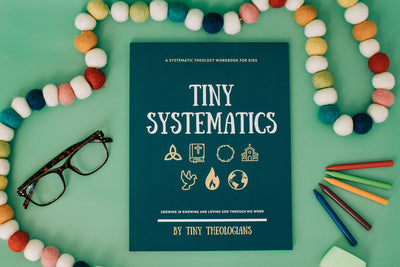
That is one of the reasons we created our Board Book Bundle: Big Truths About Our Big God. We wanted even our youngest children to hear rich truths about God's character from their earliest days. Those same truths continue to grow with children as they mature. Resources like ABCs of Theology help older preschoolers and elementary students begin connecting biblical words with biblical truth, while the Tiny Theologians Bible and Tiny Bible Survey help children see that the Bible is not simply a collection of disconnected stories but one unified story of God's redemption through Christ. As families begin hiding God's Word in their hearts together, My First Bible Verses provides an approachable place to begin memorizing Scripture.
The goal of every resource we create is not simply to give children more information. It is to help families spend more time together in God's Word, growing in their knowledge and love of the Lord.
You Don't Have to Be a Theology Expert
Perhaps the greatest obstacle for many parents is not their child's age but their own confidence. They worry they won't know the answer to every question or that they haven't studied enough themselves. If that describes you, let me encourage you with this: your children do not need a parent who has mastered systematic theology. They need a parent who loves the Lord, treasures His Word, and is willing to keep learning alongside them. Some of the sweetest moments of discipleship happen when we open our Bibles together and say, "Let's see what God says."
After all, theology is not ultimately about accumulating information. It is about knowing the God who has made Himself known. Jesus Himself said that eternal life is to know the only true God and Jesus Christ whom He has sent. Every conversation that helps our children know Him more faithfully is time well spent.
So, What Age Should You Start Teaching Theology?
If your child is old enough to ask questions, to wonder at creation, or to hear you read a Bible story before bed, they are old enough to begin learning about God. You don't have to wait until they understand everything. None of us ever will. You simply begin where they are, trusting that the God who delights to reveal Himself will continue to make Himself known as they grow!